A human rights report by the Entisaf organization documents the crimes of the Saudi-Emirati occupation in the occupied governorates.
A human rights report by the Entisaf Organization documents the crimes of the Saudi-Emirati occupation in the occupied governorates.
The Entisaf Organization for Women and Children’s Rights documented the most prominent crimes and violations committed by the Saudi-Emirati occupation in a human rights report released today entitled “Screams Under the Guardianship of Occupation.”
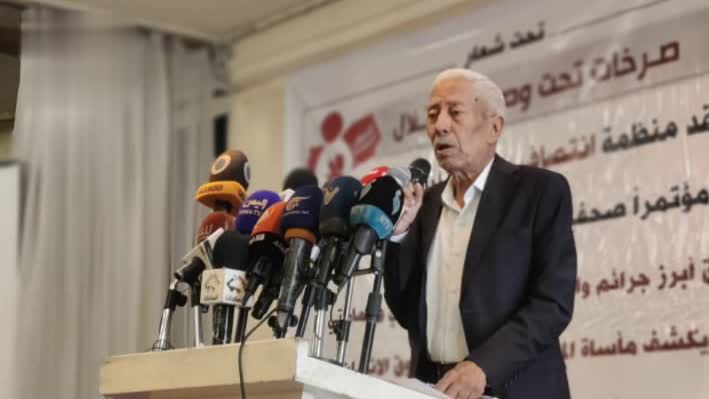
At a press conference held today in Sana’a, the organization revealed the tragedy of civilians and human rights violations in the occupied areas, resulting from the crimes and violations perpetrated by the Saudi-Emirati occupation.
At the conference, the Governor of Hadramawt, Luqman Baras, praised the efforts to hold the conference to highlight the enemy’s crimes in the occupied southern and eastern governorates and to amplify the voices of their people to all free people of the world.
He reviewed the suffering of the people of the southern and eastern governorates due to the violations committed by the Saudi-Emirati occupiers and their agents.
He emphasized the recent increase in violations against the people of these governorates, expressing his astonishment that people from these governorates would commit crimes against their own people and persecute their brothers.
For her part, Sumaya Al-Taifi, head of the Entisaf Organization, explained that the report sheds light, with facts and figures, on the nature of the situation in the occupied governorates, unraveling the threads of the political, economic, and social crisis. It seeks to hold the international community and human rights organizations accountable for their legal and humanitarian responsibilities regarding the systematic violation of the most basic rights of the Yemeni people under occupation.
She pointed out that the report’s importance lies in documenting the violations and their humanitarian and human rights consequences. It highlights the suffering caused by the deterioration of services and basic rights, and monitors violations related to sovereignty, rights, and freedoms in the occupied governorates.
Al-Taifi stated that the report preserves evidence and testimonies to support future human rights documentation and accountability efforts. This will amplify the voices of the victims and highlight their suffering to local and international public opinion, providing a comprehensive and documented picture that human rights and media organizations can utilize to demand accountability, justice, and reparations for the victims.
She stressed that the deteriorating humanitarian and human rights situation in the occupied governorates is a daily reality affecting the lives of millions of citizens who have been burdened by the occupation, human rights violations, and the decline in basic services.
For her part, Faten Sharaf al-Din, the organization’s human rights reports officer, presented a summary of the report, which addressed the legal characterization of the Saudi- and Emirati-occupied Yemeni governorates and the humanitarian and living conditions there.
The report included documents exposing the corruption of the so-called government based in foreign hotels, and highlighted the popular uprising and anger in the occupied governorates against the Saudi-Emirati occupation forces and their mercenaries.
It pointed out that, in the absence of the state and with the multiple loyalties of factions supported by the Saudi-Emirati enemy, the occupied governorates have become open arenas for grave violations and the enforced disappearance of hundreds of activists in secret prisons.
The report drew attention to violations against the most vulnerable groups, such as women and children, including assaults and systematic violence, and presented human stories of victims of killing, arrests, kidnappings, and enforced disappearances.
The report also documented airstrikes targeting civilian gatherings and facilities in the occupied governorates.
The report’s recommendations called for an immediate end to all forms of foreign military presence and intervention, the withdrawal of forces, and oversight of the restoration of full national sovereignty over Yemeni territory and territorial waters.
The recommendations called for depoliticizing the economic and service sectors, activating the role of oversight and judicial bodies to combat corruption, closing all illegal detention centers, and immediately referring detainees to the judiciary.
They also urged intensifying urgent humanitarian aid, reorganizing and unifying monetary policy, and managing it from its headquarters to ensure the cessation of the local currency’s collapse and curb inflation.
Furthermore, they demanded that all parties be pressured to respect human rights and freedom of opinion and expression, to strictly adhere to human rights standards during law enforcement, and to cease the harassment of activists, journalists, and civil society.
The recommendations stressed the importance of revealing the fate of all those abducted and forcibly disappeared, working to return them to their families, and bringing all those involved in committing violations and crimes against civilians to swift international and domestic justice, ensuring that no party escapes legal accountability.
The recommendations also highlighted the importance of lifting restrictions on sea, land, and air ports, facilitating the movement of trade and civilians, and resuming oil exports, with the revenues being used for the benefit of the Yemeni people.
The conference was attended by a number of officials from the southern and eastern governorates, and social figures.