Entesaf Organization Issues Human Rights Report Documenting the Psychological and Social Impact of Aggression and Blockade Over 12 Years
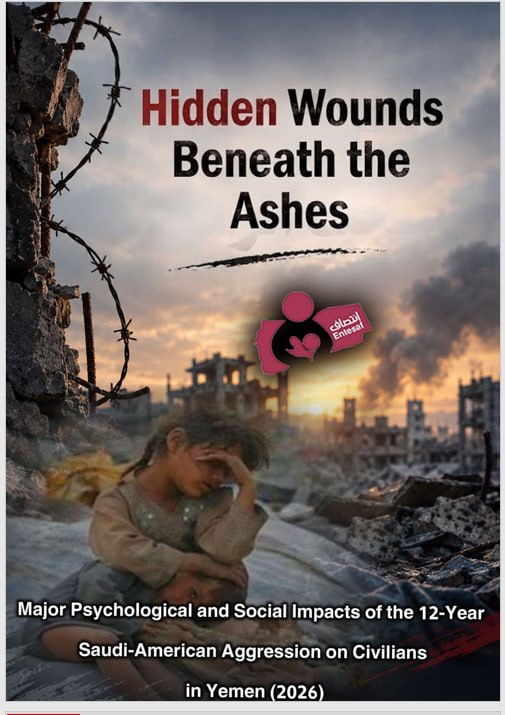
Entesaf Organization for Women and Child Rights has issued a human rights report entitled “Hidden Wounds Beneath the Ashes,” documenting the major psychological and social repercussions left by years of the Saudi-American aggression and blockade on the Yemeni people, particularly women, children, and the most vulnerable groups.
The report clarified that the consequences of the aggression and blockade were not limited to human and material losses or the destruction of infrastructure; rather, they extended to the collective memory, social fabric, and mental health. This has caused psychological trauma and disorders, a breakdown in family and community ties, and a severe worsening of economic and living pressures.
In its methodology, the report relied on the organization’s monitoring reports, official sources, and reports from local and international organizations, alongside continuous tracking of credible media outlets. This approach aimed to monitor changes in the Yemeni family unit, expose the magnitude of psychological trauma suffered by vulnerable groups, document instances of human suffering, and propose measures to alleviate their impact.
The report noted that constant exposure to airstrikes, threats, the loss of loved ones, and living instability contributed to worsening rates of anxiety, depression, and Post-Traumatic Stress Disorder (PTSD). Meanwhile, economic strain, displacement, and declining livelihoods weakened family bonds and social safety nets, imposing new challenges on many families regarding breadwinning and household roles.
Furthermore, the report highlighted several indicators and data regarding the psychological and social conditions of children and women, drawing upon data and studies from several international entities and organizations.
It stated that land shelling and airstrikes launched by the coalition since March 26, 2015, have killed or maimed more than 11,000 children—an average of at least four children killed or disabled every day. This has resulted in permanent disabilities and deep psychological trauma for victims and their families, with hundreds of thousands of children suffering from severe trauma and emotional disorders due to constant exposure to an atmosphere of terror.
The report mentioned that more than 8.8 million children are now in dire need of specialized protection services due to heightened risks of exploitation, child labor, and domestic and psychological violence exacerbated by the economic collapse caused by the blockade. Women and girls also face a sharp increase in violence risks, with millions lacking basic psychological and social protection or supporting legal services amidst the unraveling of community structures.
It emphasized that a decade of aggression and blockade deprived millions of children of a safe educational environment, pushing the number of out-of-school children past two million. This has left severe social consequences, including rising dropout rates, increased child labor, and early marriage for young girls.
According to the report, around seven million people suffer from varying degrees of psychological disorders and trauma requiring specialized intervention due to continuous psychological pressure. However, only 120,000 people can access mental health services annually. This leaves 6.88 million cases—over 98 percent—without basic mental healthcare, a massive gap directly resulting from the brutal aggression and blockade on the country.
The report pointed out that nearly 73 percent of children show symptoms of PTSD due to ongoing exposure to threats and terrifying news. Additionally, 67 percent of women suffer from high anxiety levels, and about 62 percent face the risk of severe depression due to the combined toll of hardship and persistent psychological warfare.
Moreover, 80 percent of displaced persons (who now exceed 4.8 million) are women and children. At least 22.1 percent of the total population suffers from a mental health disorder, while the total number of psychiatrists across the entire country does not exceed 46—a ratio of just one psychiatrist for every 700,000 people.
The report also addressed the impact of media warfare and soft warfare on civilians, noting their effects on public awareness, psychological stability, social cohesion, and the aggravation of psychological stress.
It stressed that protecting civilians from psychological and social harm is anchored in the international legal framework, referencing International Humanitarian Law, International Human Rights Law, and the special protections guaranteed by the Convention on the Rights of the Child for children affected by armed conflicts.
In conclusion, Entesaf Organization called for an end to all forms of aggression and the land, sea, and air blockade, as well as a cessation of economic and humanitarian pressure on civilians. It urged the launch of supported national and local programs for mental health and psychological support—focusing on women and children—alongside promoting community awareness and supporting grassroots initiatives that help revive solidarity and create safe spaces for community support.
The organization considered this report a crucial step toward shedding light on the invisible dimensions of civilian suffering and presenting these psychological and social realities to relevant authorities and humanitarian organizations to support recovery pathways for Yemeni society.