On the occasion of the 4,000th day of the US-Saudi aggression against Yemen, coinciding with International Women’s Day on March 8th
On the occasion of International Women’s Day, marking 4,000 days since the start of the aggression, the “Entisaf for Women and Child Rights” organization revealed shocking statistics documenting the scale of the humanitarian tragedy that has befallen women and children in Yemen. These figures, which come amidst a suspicious international silence, expose the hollowness of international slogans about human rights, confirming that what Yemeni women have been experiencing for a decade—killing, displacement, and siege—exceeds all human rights descriptions and places the international community before a moral test that it has failed for thousands of days.
In its statement issued on the 4,000th day, the organization revealed shocking statistics documenting the extent of the direct and indirect targeting by the US-Saudi aggression coalition.
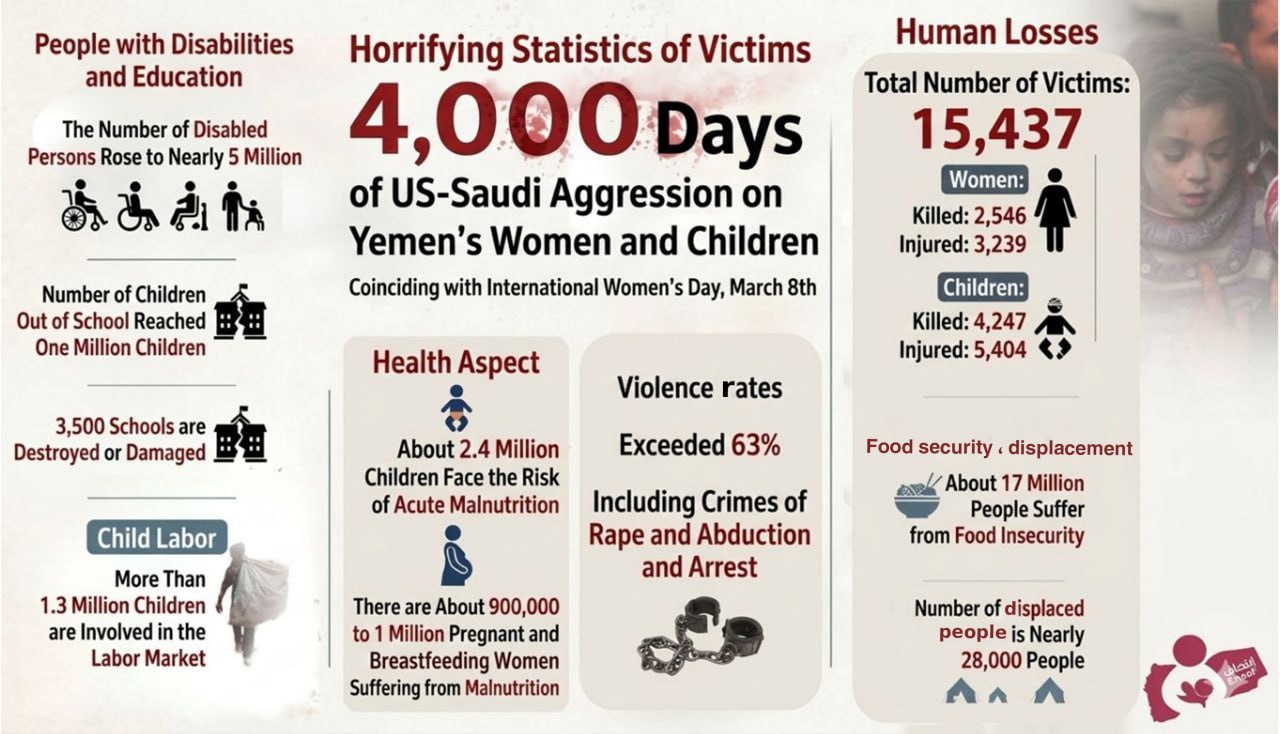
The Entisaf Organization for Women and Child Rights reported that the number of victims of the US-Saudi aggression, including children and women, exceeded 15,437 killed and wounded as of March 2026.
In a statement, the organization clarified that the number of women killed and wounded reached 5,786, including:
2,547 martyrs and 3,239 wounded. The number of children killed and wounded reached 9,651, including 4,247 killed and 5,404 wounded.
Reports indicate that Yemen is among the countries suffering from severe food insecurity, facing catastrophic levels of hunger, with approximately 17 million people suffering from acute food insecurity.
The statement also noted that the number of displaced persons rose to nearly 28,000 last year. Statistics indicate that half of the displaced are women and children, with 1.71 million displaced children and 27 percent of displaced women under the age of 18. Their vulnerability to violence increases, with rates exceeding 63%, including rape, kidnapping, and arbitrary arrest.
The organization noted that with limited shelter options, displaced women and girls suffer the most from a lack of privacy, threats to their safety, and limited access to basic services, making them more vulnerable to violence and abuse. The statement added that one in three displaced households is headed by a woman, and the girls who are the primary breadwinners in 21% of these households are under 18 years old.
The statistics also indicated that the number of people with disabilities has risen to nearly 5 million, representing approximately 15% of Yemen’s total population—one of the highest rates globally. It was also revealed that nearly one million children in Yemen suffer from various disabilities.
Regarding education, the statistics indicated that 4.5 million children are out of school, meaning that one in four children in Yemen is not attending school. The report also stated that approximately 6 million children are at risk of dropping out of school due to poverty and the destruction of schools.
It further explained that nearly 3,500 schools are either destroyed or damaged, with about 27% of schools across the country closed. Additionally, 66% of schools have been damaged by severe violence, and 7% are being used as shelters for displaced people. The organization noted that teachers have also been affected by the aggression and blockade, with an estimated 171,600 teachers—or two-thirds of the teaching workforce—not receiving their salaries regularly since 2016. This has forced them to stop teaching to find other ways to support their families, putting nearly four million more children at risk of losing access to education.
The statement also indicated that 31 percent of Yemeni girls are now out of school due to the deteriorating humanitarian situation and families’ inability to provide basic educational necessities.
The statement further highlighted the expansion of child labor during the aggression, which has more than quadrupled compared to previous levels. It noted that approximately 1.3 million children are engaged in the labor market in Yemen, with the latest international statistics indicating that around 12.5% of children aged 5-14 are involved in some form of work.
Women and children in Yemen are facing a catastrophic malnutrition crisis, with 75% of children suffering from chronic malnutrition. Acute wasting threatens nearly 50% of children under five (approximately 2.4 million children), and two million pregnant and lactating women require treatment for malnutrition. Reports indicate that 39.5% of the population suffers from acute malnutrition amidst the collapse of health and nutrition services. An estimated 900,000 to one million pregnant and lactating women are suffering from malnutrition, and complications of malnutrition lead to the death of three women every day in Yemen.
The statement continued, noting that only 51% of health facilities are functioning in Yemen, and that nearly 70% of essential maternity medications are unavailable due to the blockade and the Saudi-led coalition’s prevention of their entry. It asserted that more than 50% of infant deaths could be prevented if basic healthcare were provided.
The organization held the US- and Saudi-led coalition responsible for all crimes and violations committed against civilians, particularly women and children, over the past 4,000 days. It called upon the international community, UN organizations, and human rights and humanitarian bodies to assume their legal and humanitarian responsibility for the violations and horrific massacres perpetrated against civilians.
The organization urged all freedom-loving people worldwide to take effective and positive action to stop the aggression, protect civilians, and establish an independent international commission to investigate all crimes committed against the Yemeni people and hold accountable all those found to be involved.
Sana’a | March 8, 2026