A Human Rights Report Documents Violations and Deteriorating Humanitarian Conditions in the Occupied Governorates
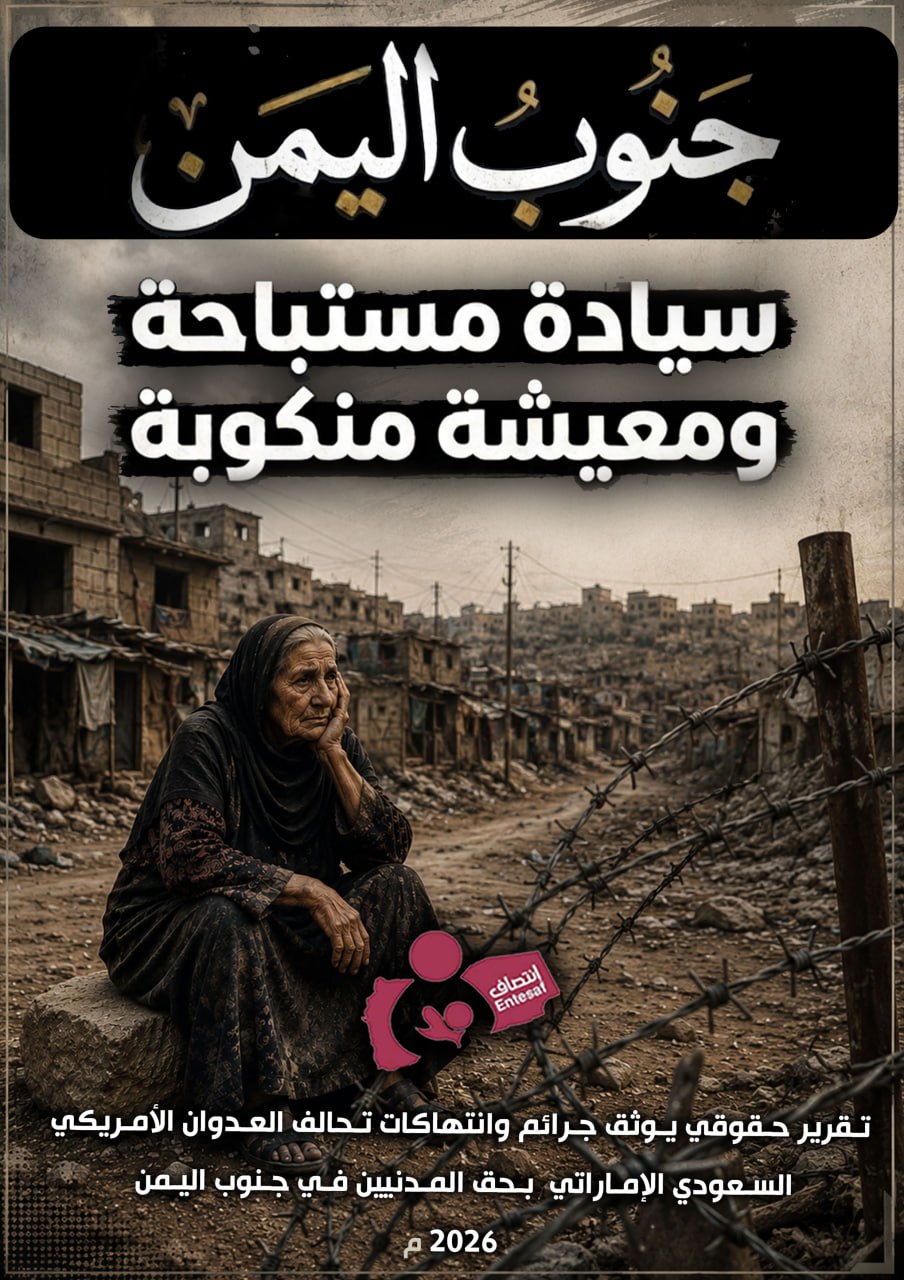
The #Entisaf Organization for Women and Children’s Rights issued a human rights report documenting violations and the deteriorating humanitarian situation in the occupied southern and eastern governorates, titled “South Yemen: Violated Sovereignty and a Disaster-Stricken Livelihood.”
The report addressed the humanitarian, economic, social, and human rights conditions in the southern governorates, documenting some of the violations committed against civilians and the impact of the occupation on citizens’ lives and basic services. It also discussed the legal characterization of the Saudi-led and Emirati-backed occupation of the southern regions.
The report explained that the southern governorates are experiencing a deteriorating humanitarian and living situation due to the convergence of political, economic, and social crises and their impact on citizens’ lives, amidst declining basic services, a depreciating local currency and purchasing power, and the disruption of several vital economic facilities.
The report relied on the organization’s field monitoring, reports issued by official bodies and international organizations, and continuous monitoring of official and reliable media sources, with the aim of monitoring and documenting violations and highlighting their humanitarian and human rights consequences. The report indicated that the deteriorating economic situation has directly impacted citizens, with soaring food and fuel prices and a decline in purchasing power. Families are facing increasing difficulties in securing their basic needs, coinciding with a decline in the quality of public services. Inflation rates for food commodities have exceeded 300% compared to previous years, and more than 80% of families are unable to afford basic meals due to irregular salaries and the erosion of their purchasing power.
The report further noted that the control of ports and economic facilities, along with the disruption of oil and gas production and exports, has deprived the Yemeni economy of resources that could have been used to finance public services, operate health and educational facilities, and improve citizens’ living conditions.
The report stated that members of the so-called government, residing in Riyadh hotels, continue to plunder, defraud, and embezzle Yemeni citizens. They live abroad with their families in extravagant luxury, while citizens in the occupied areas endure catastrophic and tragic conditions, with many unable to secure their daily bread. The report also presented documents exposing the corruption and plundering perpetrated by this government. The report stated that the health sector is suffering from a near-total collapse of its infrastructure, with more than 45 to 50 percent of health facilities either completely or partially out of service due to a lack of operating funds and shortages of medicines and supplies.
The report also noted that the decline in support and the disruption of vital, revenue-generating facilities have led to unprecedented outbreaks of cholera. The World Health Organization recorded a cumulative total of 93,496 confirmed and suspected cholera cases and 248 deaths related to the epidemic in 2025, making Yemen the second most affected country in the world. The crisis continued into 2026, with transmission rates rising and more than 3,177 new cases recorded in the first quarter of the year, placing Yemen among the countries with the highest cholera burden globally. According to the report, the occupied southern governorates (especially Aden, Lahj, and the Hadramawt coast) witnessed a sharp and alarming increase in dengue fever cases. During the first half of 2026, the country recorded more than 5,786 confirmed cases of dengue fever and 30 deaths.
The report indicated that Aden was the epicenter of the outbreak, with 1,243 cases and 12 deaths recorded there alone, representing approximately 67 percent of the total fatalities. Thousands of suspected cases and dozens of deaths were also reported. The report further noted that the United Nations Population Fund (UNFPA) had reduced its life-saving programs by 40 percent. This drastic reduction has jeopardized the lives of more than two million women and girls, preventing them from accessing safe maternal care and cesarean sections. This has resulted in an average of three women dying daily during childbirth due to preventable complications. The report also addressed the state of the health sector, highlighting the deteriorating conditions of government hospitals, shortages of medicines, medical supplies, and operational budgets, and the resulting exacerbation of patient suffering. This coincided with the resurgence and spread of certain diseases and epidemics in several southern governorates.
On the human rights front, the report documented cases of arbitrary arrests, enforced disappearances, and violations within detention centers. It noted the proliferation of illegal prisons and detention centers in several southern governorates, amidst the multitude of armed militias and the decline of state institutions.
Statistics indicate the existence of a network of at least 18 secret prisons run by the UAE and its armed factions in the southern governorates, where detainees are subjected to systematic and brutal torture. The report also confirms 1,200 cases of arbitrary arrest and abduction, and hundreds of cases of enforced disappearance in prisons run by UAE-backed armed militias. The report further stated that the campaign of arrests and raids that accompanied the popular protests demanding improved services and living conditions in Aden targeted more than 14 activists and citizens. He addressed the violations suffered by the families of detainees and those forcibly disappeared, documenting cases of blackmail and the detention of mothers and wives as a means of pressuring their relatives, in addition to financial demands in exchange for information about the fate of the detainees.
The report documented the psychological and social repercussions of the deteriorating living, economic, and security conditions. It explained that continuous pressures, economic collapse, and living under the shadow of armed militias have had a profound impact on the mental health of citizens and on social cohesion. Statistics indicate that nearly 80 percent of the population suffers from some form of psychological disorder, such as severe anxiety, depression, and trauma-related behavioral disorders, resulting from the deteriorating living conditions and lack of security.
The report stated that the southern and eastern governorates have witnessed a steady increase in cases of domestic violence, exceeding 36 percent. This rise is directly attributed to the increasing financial pressures on heads of households due to the currency collapse and the interruption of salaries.
The report also noted a significant increase in divorce, khula (divorce initiated by the wife), and family disputes in recent years as a result of the complete financial incapacity of the head of the household. Local human rights estimates indicate that the economic and living crises are behind more than 65 percent of newly registered separation cases in the southern governorates.
He emphasized that the economic collapse and families’ struggle to secure basic necessities have led to a surge in child labor in the southern governorates, which are suffering from severe currency devaluation. Approximately one in four school-aged children are forced to work in arduous or dangerous jobs (such as street vending, auto repair shops, and plastic collection) to financially support their families, leaving a devastating psychological and social impact on their future.
The report also addressed the popular protests that have swept through Aden since June 2026, sparked by deteriorating living conditions and prolonged power outages. These protests escalated into sit-ins, road blockades, and civil disobedience before being met with a campaign of arrests and raids targeting numerous participants. The report presented real-life human stories of individuals subjected to violations by the Saudi-American-Emirati occupation and its mercenaries.
In its report, the Entisaf Organization stressed that the situation in the southern governorates necessitates serious action from the international community, the United Nations, and international human rights organizations and bodies to pressure for an end to violations, the protection of civilians, and the guarantee of respect for international humanitarian law and international human rights law.
The organization called for an end to all forms of foreign military presence and intervention, the restoration of national sovereignty, the depoliticization of economic and service sectors, the activation of oversight and judicial bodies to combat corruption, the closure of illegal detention centers, and the referral of detainees to the judiciary.
The organization stated that the report is part of its human rights efforts aimed at monitoring and documenting violations against civilians and conveying the facts related to the humanitarian and human rights situation to the public, international organizations, and relevant parties, thereby contributing to strengthening the protection of civilians, demanding accountability for perpetrators of violations, and ensuring justice for victims.