Entesaf Organization Issues Human Rights Report Documenting the Psychological and Social Impacts of 12 Years of Aggression and Blockade
Entesaf Organization Issues Human Rights Report Documenting the Psychological and Social Impacts of 12 Years of Aggression and Blockade
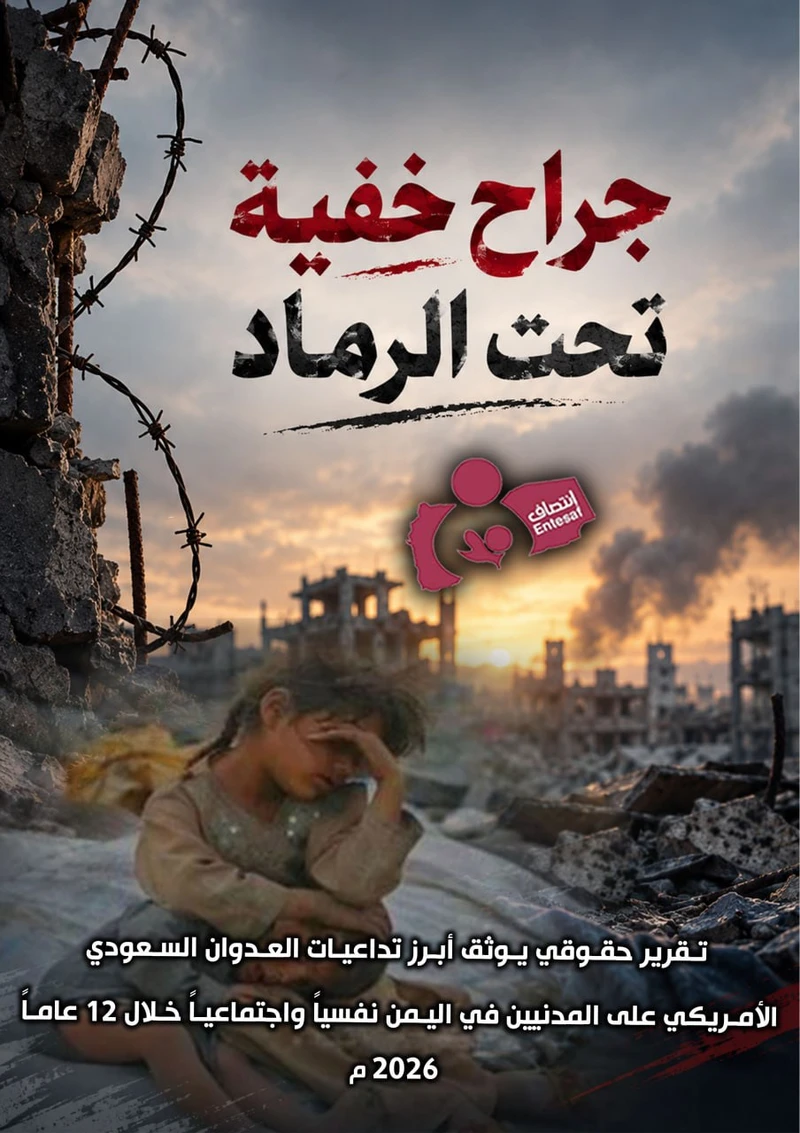
Entesaf Organization for Women and Child Rights has issued a human rights report entitled “Hidden Wounds Beneath the Ashes,” documenting the most prominent psychological and social repercussions resulting from years of Saudi-American aggression and blockade against the Yemeni people, particularly women, children, and the most vulnerable groups.
The report explained that the repercussions of the aggression and blockade have extended beyond human and material losses and the destruction of infrastructure to affect collective memory, social cohesion, and mental health. These consequences have contributed to psychological trauma and disorders, weakened family and community ties, and intensified economic and livelihood pressures.
According to the report, its methodology was based on the organization’s monitoring reports, reports issued by official sources and local and international organizations, as well as continuous monitoring of official and reliable media sources and websites. The objective was to monitor changes affecting Yemeni families, assess the scale of psychological trauma among vulnerable groups, document examples of humanitarian suffering, and develop proposals to mitigate its consequences.
The report noted that continued exposure to airstrikes and threats, the loss of loved ones, and the absence of livelihood stability have contributed to increased levels of anxiety, depression, and post-traumatic stress disorder (PTSD). Economic pressures, displacement, and declining livelihood opportunities have also weakened family ties and social support networks, creating new challenges for many families in terms of providing for their members and distributing responsibilities.
The report addressed a number of indicators and data concerning the psychological and social conditions of children and women, drawing on data and studies cited from various international organizations and institutions.
It stated that ground shelling and airstrikes carried out by the coalition since March 26, 2015, have resulted in the killing or maiming of more than 11,000 children, at an average of no fewer than four children killed or injured every day. The report said this has left permanent disabilities and deep psychological trauma among victims and their families, while hundreds of thousands of children suffer from severe psychological trauma and emotional disorders as a result of prolonged exposure to an atmosphere of fear and violence.
The report further stated that more than 8.8 million children are now in urgent need of specialized protection services due to increased risks of exploitation, child labor, domestic violence, and psychological abuse amid the economic collapse resulting from the blockade. Women and girls are also facing a sharp increase in risks of violence, while millions lack access to basic psychological and social protection and legal support services amid the deterioration of community structures.
It emphasized that a decade of aggression and blockade has deprived millions of children of a safe educational environment, with more than two million children out of school. This has resulted in serious social consequences, including increased school dropout rates, child labor, and early marriage among girls.
According to the report, approximately seven million people suffer from psychological disorders and varying degrees of trauma requiring specialized intervention, while only around 120,000 people are able to access mental health services each year. This means that approximately 6.88 million people—more than 98 percent of those experiencing psychological disorders—do not receive essential mental health services, a significant increase that the report attributes to the ongoing aggression and blockade.
The report also indicated that approximately 73 percent of children exhibit symptoms of post-traumatic stress disorder as a result of continued exposure to threats and distressing news. It further stated that 67 percent of women experience high levels of anxiety, while approximately 62 percent face risks of severe depression due to the combined effects of harsh living conditions and the continuous psychological pressures of war.
According to the report, 80 percent of displaced people, whose number has exceeded 4.8 million, are women and children. It also stated that at least 22.1 percent of the population suffer from one or more psychological disorders, while the total number of psychiatrists across Yemen does not exceed 46, equivalent to approximately one psychiatrist for every 700,000 people.
The report also examined the impact of media warfare and what it described as “soft warfare” on civilians, highlighting their effects on public awareness, psychological stability, and social cohesion, as well as their contribution to increasing psychological pressures.
The report stressed that protecting civilians from psychological and social harm is also linked to the international legal framework, drawing on the provisions of international humanitarian law and international human rights law, as well as the special protection afforded to children affected by armed conflict under the Convention on the Rights of the Child.
At the conclusion of the report, Entesaf Organization called for an end to aggression and blockade in all its forms—by land, sea, and air—and for an end to economic and humanitarian pressure on civilians. It also called for the launch of nationally and locally supported mental health and psychological care programs, with a particular focus on children and women, alongside strengthening community awareness programs and supporting civil society initiatives and associations that contribute to reviving solidarity and mutual support and creating safe spaces for community-based assistance.
The organization described the report as a step toward shedding light on the less visible dimensions of civilian suffering and placing the psychological and social repercussions before relevant authorities and humanitarian organizations, thereby contributing to efforts aimed at psychological and social recovery within Yemeni society.